Palliative care workers document a pattern that repeats in hospice rooms across the country – “I wish I’d had the courage to express my feelings” ranks among the top three regrets of the dying. These people suppressed what mattered to keep peace with others, and the suppression manifested as physical illness from accumulated bitterness and resentment.
The transmission window closed before they found the courage to send the signal.
I’ve watched this pattern play out in ministry work for decades – people run out of time to say what needs to be said, and the failure looks different depending on the person. Some accept it and move on. Others get flustered because they feel misunderstood, and that feeling of being misunderstood becomes the legacy they leave behind instead of the truth they meant to transmit.
The Interference Problem
When someone feels misunderstood after running out of time, the mechanism that prevented transmission is usually straightforward – they got interrupted, or they lacked situational awareness about how little time remained. The interference patterns in real-time conversation prevent people from saying “I forgive you” or “I was wrong” or whatever the critical message is.
The other person’s passivity creates interference. Their dismissiveness creates interference. The lack of situational awareness on both sides creates interference.
This only happens in synchronous conversation where both people are present.
Research on asynchronous communication demonstrates that removing the requirement for the other person to be in the room fundamentally alters the psychological experience – it “allows for a greater degree of cognitive processing and emotional regulation before a response is formulated.” Translation: thoughts can flow without interruption. You can pause, regather your thoughts, and continue instead of losing your train of thought to someone’s dismissive reaction or passive withdrawal.
The Tomorrow Delusion
I’ve watched people procrastinate on these critical transmissions for years, sometimes decades. They know time isn’t infinite – the knowledge exists conceptually. The psychological block that keeps someone from recording that message today instead of waiting for “the right moment” that never comes is simple: the busyness of life combined with the belief that they have tomorrow.
They live in a fantasy land where all productivity is stored in the land of tomorrow, and tomorrow never comes around.
Research published in The Journal of General Psychology found that men with higher death anxiety engage in more bedtime procrastination – they avoid sleep because “time spent during sleep is not a period of time lived consciously and may take away from individuals’ total life span.” The contradiction is remarkable: people anxious about mortality paradoxically procrastinate on the very actions that would create meaning before time runs out.
Knowing something conceptually doesn’t change behavior.
If the behavior doesn’t follow suit, do you really believe in the principle? This is the problem – those who aren’t showing the fruit or the manifestation of actual behaviors are just thinking about it conceptually, and conceptual knowledge doesn’t matter when the transmission window closes.
The Re-Indoctrination Mechanism
The industry has built entire platforms around “staying connected” – but if someone’s operating in this fantasy land where tomorrow is guaranteed, communication tools don’t break through that delusion. They just enable more procrastination through the illusion of constant connection.
Approximately 27% of Americans – 67 million people – are currently estranged from a family member. The average duration of estrangement is nine years. While 79% of estranged family members believe reconciliation will never happen, research shows that 81% of maternal estrangements and 69% of paternal estrangements eventually end in some degree of reconciliation.
But only after years of lost time that can never be recovered.
A slight re-indoctrination happens when people you love and care about start sending you memoirs and videos and things of importance. Receiving becomes the catalyst for creating – someone gets a video from their father or their daughter and suddenly the conceptual becomes behavioral. The exposure to other people doing the work emphasizes the fact that you need to prioritize these things as well.
The Truth Transmission Question
When that person finally sits down to record their own message, what makes them actually transmit the hard truth instead of just recording something safe and comfortable?
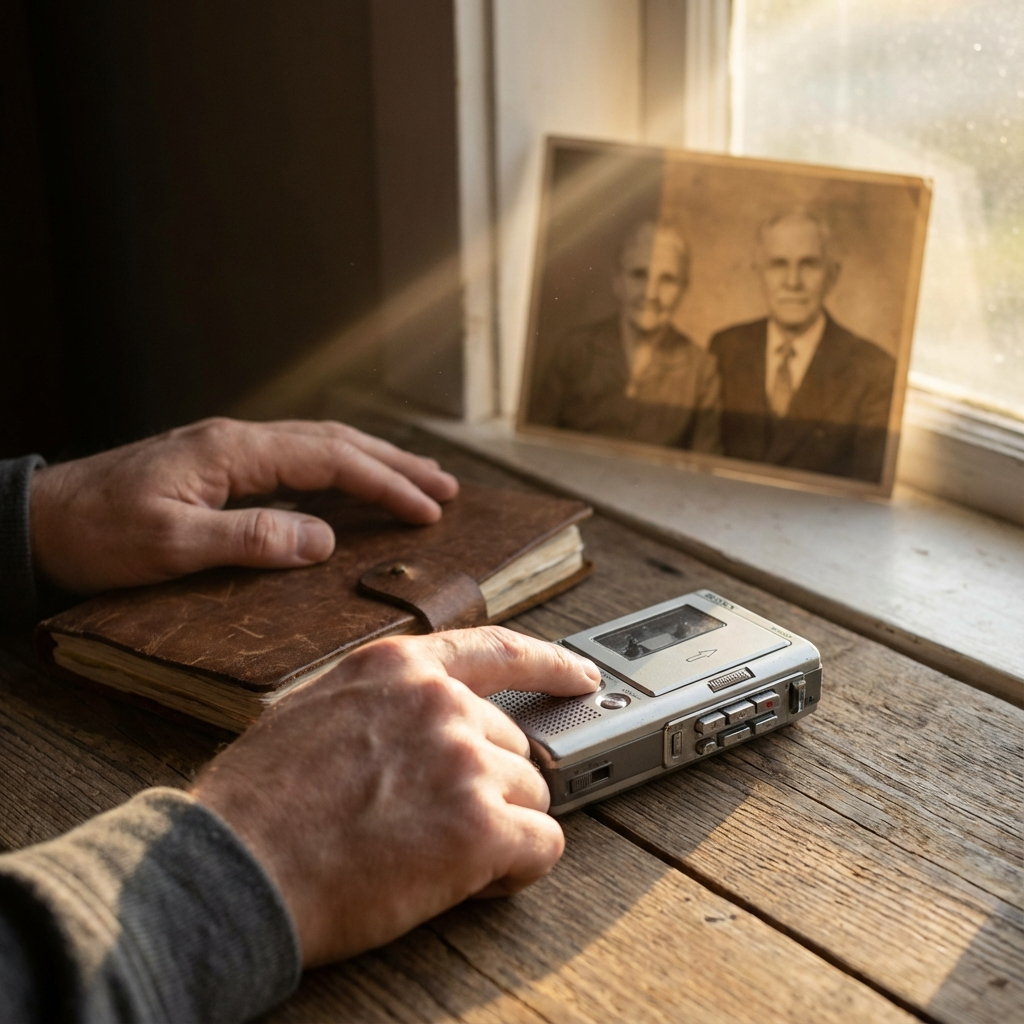
The answer reveals the flexibility of asynchronous preservation – you can record something safe and comfortable, but you can also record hard truths and things you can’t say in front of somebody else. You can even upload family videos and send them to the future that you want to re-see again.
The mechanism doesn’t force authenticity – it removes the barriers to authenticity.
Research on peer feedback shows that asynchronous communication “can bolster communication, emotional regulation, and higher order thinking skills” specifically because it removes the pressure of immediate response and the emotional reactivity that corrupts message transmission in synchronous exchanges.
The Legacy Industry Lie
The industry sells legacy preservation as optional nostalgia – something nice you’ll get around to eventually, like organizing old photos or writing your memoirs. This framing treats legacy as backward-looking documentation of the past.
The reality is different.
Cornell Family Reconciliation Project researcher Karl Pillemer found that elderly participants identified family estrangements as “the most disruptive and distressing” events of their entire lives – more than career failures, financial losses, or health crises. Those who successfully reconciled after 10, 20, or even 30 years described it as “transformative.”
But the decades of silence represented irretrievable relational capital.
Legacy preservation isn’t about remembering the dead – it’s about preventing future regret through present action. It’s urgent reconciliation work with a closing window, not optional documentation of what already happened.
The Mortality Awareness Gap
Hospice specialist Dr. BJ Miller observed: “There’s no guarantee for tomorrow, ever.” He emphasizes that “the enemy is not death – the enemy is a wasted life” spent avoiding the hard truths that matter most.
Research on mortality salience shows that simply being reminded of death without deeper acceptance “increases activation in areas of the brain regarding guilt and shame” and triggers defensive cultural behaviors rather than meaningful action. The problem isn’t awareness – awareness without a mechanism for transmission becomes paralysis.
Death awareness researcher Alua Arthur states: “Grounding in my mortality means that at some point I won’t have access to all these senses anymore” – yet this awareness typically emerges only at the end of life, when palliative care workers observe “the phenomenal clarity of vision that people would gain” about what actually mattered.
The structural failure: people gain clarity when the transmission window has already closed.
The Platform Design Question
Current platforms optimize for engagement metrics that steal time rather than preserve relational depth. Email and similar platforms “eliminate the cues that regulate emotional safety in conversation” including “vocal tone, facial expression, and body language,” forcing “the brain to rely on internal inference” and creating “chronic exposure to unresolved signals” that dysregulates stress response systems.
Platforms can corrupt even asynchronous communication when designed for engagement rather than preservation.
The distinction matters: algorithmic engagement optimization equals noise. Intentional asynchronous preservation equals signal. Attention capture equals noise. Relational reconciliation equals signal.
The question isn’t whether you’re communicating – you’re already doing that constantly through texts, calls, social media posts, and emails. The question is whether you’re preserving what actually matters before mortality makes it impossible.
Are you transmitting truth or just generating noise?
Because the people who love you will eventually receive videos and memoirs from others in their lives, and they’ll wonder why you never sent yours. They’ll assume you didn’t care enough to prioritize it, or that you ran out of time before you found the courage.
And they’ll be right on both counts.
Leave a Reply
You must be logged in to post a comment.