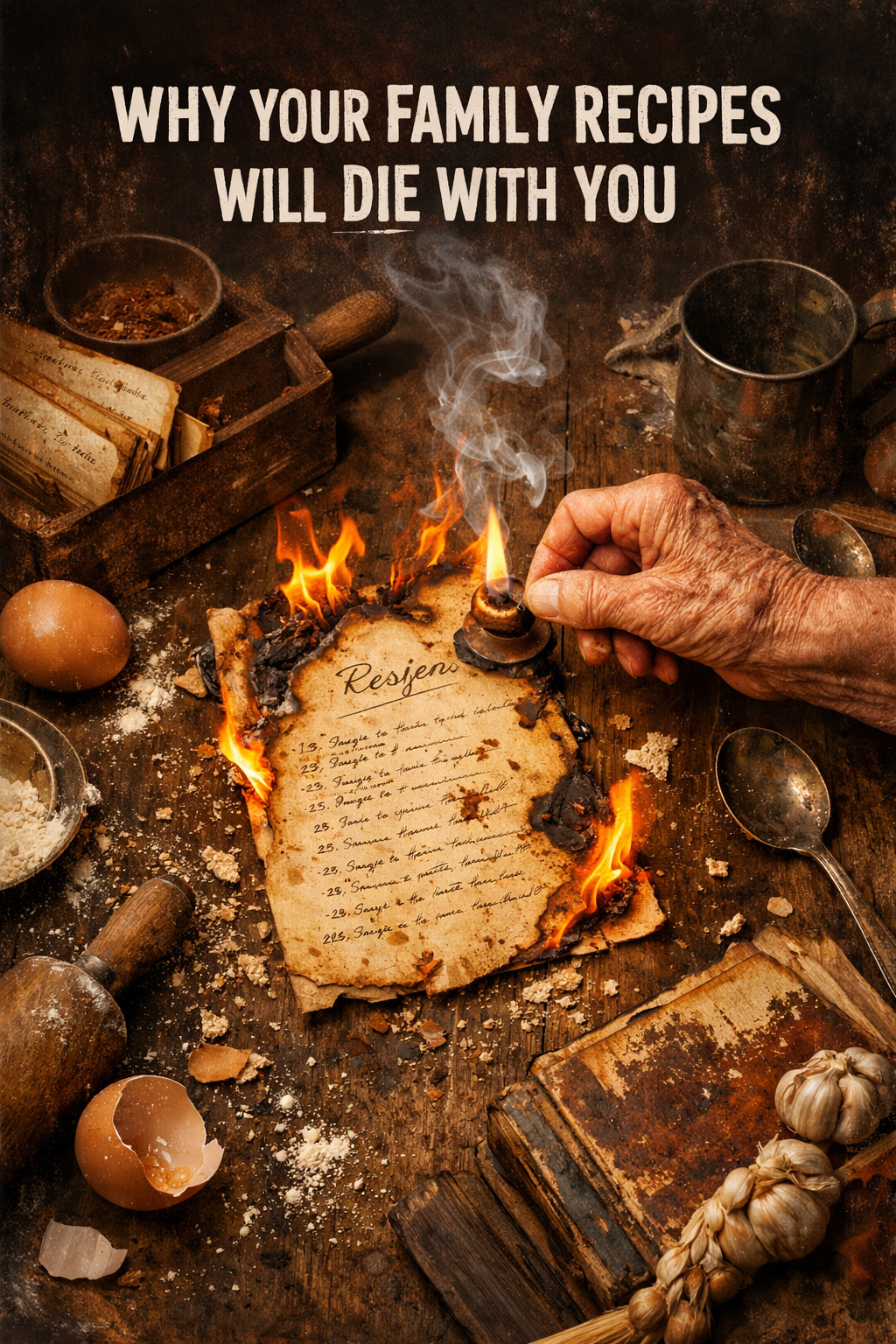
Only 37% of people who have family recipes actually know how to make them.
That’s not a cooking problem. That’s a transmission failure happening in real time across families who believe they’re successfully passing down traditions. While 71% of Americans say their family has traditional recipes, the knowledge isn’t making it to the next generation – and the gap between intention and execution reveals something uncomfortable about how we treat time.
I’ve spent decades in ministry observing this pattern. Love gets activated in those holiday moments when recipes get mentioned and stories come up. The emotional experience is real – it creates what psychologists call core memories. But memories fade. The specific moments that carry the most value get lost because we humans can only retain so much, and our ability to remember new information starts declining noticeably from our 50s or 60s.
The very generation meant to transmit knowledge is experiencing cognitive decline during the critical transmission years.
The Documentation Delusion
People think writing it down solves the problem. They take photos, record videos, keep journals – and then the content stays trapped on a device or in a box. Not everyone has access to the photo album or the journal, and even when they do, it doesn’t fully capture the moment, the actions, the conversations the way video does.
But here’s what I observe happening: someone records their grandmother explaining the family remedy or demonstrating the recipe. The video sits on their phone. Life happens – the busyness, the procrastination, the assumption that there’s time to organize it later. Then mortality arrives. A car accident, a sudden illness, and delivery becomes literally impossible.
The content dies with the device or gets lost in an estate cleanout.
Research on intergenerational transmission shows that knowledge about food was once conveyed in close proximity from mother to daughter or grandmother to grandchild. Geographic mobility separates families now. Rapid technological change creates a perceived gap in relevance – younger generations view older skills as obsolete. The natural flow of knowledge gets disrupted, and we’re watching a decline in traditional ecological and culinary knowledge that links communities to place and cultural heritage.
Chef Jamie Oliver notes that many people in the last three generations weren’t taught to cook at home or at school. Priorities have completely changed. We’ve lost touch with real food.
The Mortality Blindness Problem
Young people tend to have abstract thoughts about time. But here’s what the research reveals: death awareness can be one of the best remedies against laziness and procrastination. When you realize time is short to do and experience the life you want here on earth, behavior changes. Buddhist meditation practice shows that mindfulness of death severely reduces procrastination.
Yet procrastination affects about a quarter of the general population and impacts half of all students.
We operate under a false assumption that knowledge-holders remain available indefinitely for “one more conversation” that never gets scheduled. I’ve watched families lose entire cultural traditions because one side “decided to abandon and destroy all traits of their culture, recipes included” when they immigrated. The loss isn’t waiting for some future crisis – the erosion has already begun.
One family preserving a three-day tamale recipe explained that their grandmother was able to continue indigenous traditions through oppression. “That’s the price she paid for tamale making to be handed down and continued. And it’s such a lost art.” Without recipes being passed down, the rare and unique taste of a family dish is lost to time. The loss is permanent and irreversible.
The Synchronous Trap
When families try to sit down and share these legacies in real-time, interference patterns derail the transmission. Interruptions happen. Emotional reactivity surfaces. The timing is wrong – the knowledge-holder is ready to share, but the recipient isn’t ready to receive. Or the recipient finally wants to learn, but the knowledge-holder is no longer available.
Intergenerational transmission may not occur in all families, and some children seem more strongly affected by the behavior or characteristics of their parents than others. Even when knowledge exists, transmission fails unpredictably. The research emphasizes that intergenerational learning involves the informal transmission of knowledge, skills, and values within multigenerational households as part of everyday life.
But that requires physical proximity and time that modern displaced families lack.
What Actually Works
The solution isn’t more emotional urgency or better intentions. It’s separating transmission from reception. With cloud technology and virtual servers, content can be recorded, uploaded, and viewed at convenience. The platform can prompt you – remind you that this video was or is important to you. Set it to remind you of the recipe in a year or whenever you want.
More importantly, it can be delivered to the right person at the right time, even if you’re no longer here to hand it to them.
This removes the synchronous requirement. You can speak when you’re ready. They can receive when they’re prepared. No real-time negotiation. No emotional interference. No timing misalignment.
Research shows that greater mortality awareness with acceptance leads people to place a higher priority on the needs of future generations. But awareness alone doesn’t solve the delivery problem. The mechanism matters – and most platforms optimize for attention capture rather than relational depth. They operate on the false assumption of infinite time. They treat communication as transactional broadcast instead of targeted preservation.
Importance and urgency will eventually come from groupthink – from other people also sending videos and demonstrating how much it matters to preserve the time. But you don’t have to wait for that cultural shift.
What Are You Waiting For?
The recipes you think you’re passing down aren’t making it to the next generation. The traditions you mention at holidays aren’t being retained. The healing remedies your grandmother knew are fading from memory while you assume there’s time to record them later.
What makes you believe time remains available?
The knowledge-holders in your family are experiencing cognitive decline right now. Geographic separation is preventing the natural proximity that once enabled transmission. The busyness of life is pushing these conversations to “someday” – and someday has a terrible track record of actually arriving.
You can keep operating under the assumption that meaningful communication requires synchronous presence and perfect timing. Or you can recognize that authenticity emerges when transmission is separated from reception, allowing the signal to remain uncorrupted by real-time interference patterns.
The question isn’t whether your family’s legacies matter. The question is whether you’re treating time as the non-renewable resource it actually is – and whether you’re willing to act before mortality makes delivery impossible.
This is what i Love about You. iLoveView Now – i Love You Forever
Leave a Reply
You must be logged in to post a comment.