Something unexpected happens when you know a message will arrive in the future.
You think differently about what to say. You speak to who they’ll become, not who they are right now.
A grandmother recording for a wedding her grandchild hasn’t planned yet. A father speaking to a business his son hasn’t started. Future-facing messages create present-moment clarity in ways real-time conversations never can.
Your Brain Treats Future-You Like a Stranger
Research from UCLA psychologist Hal Hershfield reveals something fascinating about how we think about our future selves. When people imagine themselves years from now, brain imaging shows neural patterns more similar to thinking about a stranger than thinking about themselves.
You’re literally treating future-you like someone else’s problem.
This explains why you make short-term decisions that hurt your long-term interests. Why you skip the difficult conversation today assuming you’ll have time tomorrow. Why you put off recording that message for your kids because you’ll “do it when things slow down.”
But writing to your future self—or to someone else’s future self—bridges this gap. It forces you to see the future as real, inhabited by real people you’re in relationship with and accountable to.
When you record knowing the message arrives later, you’re no longer speaking to the present moment. You’re speaking to a version of reality you won’t witness.
That changes everything about what you choose to say and how you say it.
The Removal of Real-Time Interference
I’ve watched this pattern emerge across countless scenarios. People express what’s needed instead of what’s safe. They’re able to leave messages of love or regret, and they speak freely because they know it won’t be heard today.
It won’t be interrupted. It won’t be rebuttaled or rebuked. It’s going to have a free flow.
Research on computer-mediated communication confirms what I’ve observed—asynchronous formats create a safer communication context than many face-to-face interactions, especially for negative emotions. The relative absence of immediate judgment results in greater intimacy and closeness because you’re less concerned with the impression you’re making or the vulnerability you’re displaying.
The opportunity to reflect on your message without real-time emotional reactivity changes what becomes possible.
This isn’t about avoiding difficult conversations. It’s about recognizing that some truths emerge only when you remove the interference pattern of immediate response. Some reconciliations require the space to speak without eruption.
Authenticity increases when you eliminate the restriction of being face-to-face.
What People Actually Remember
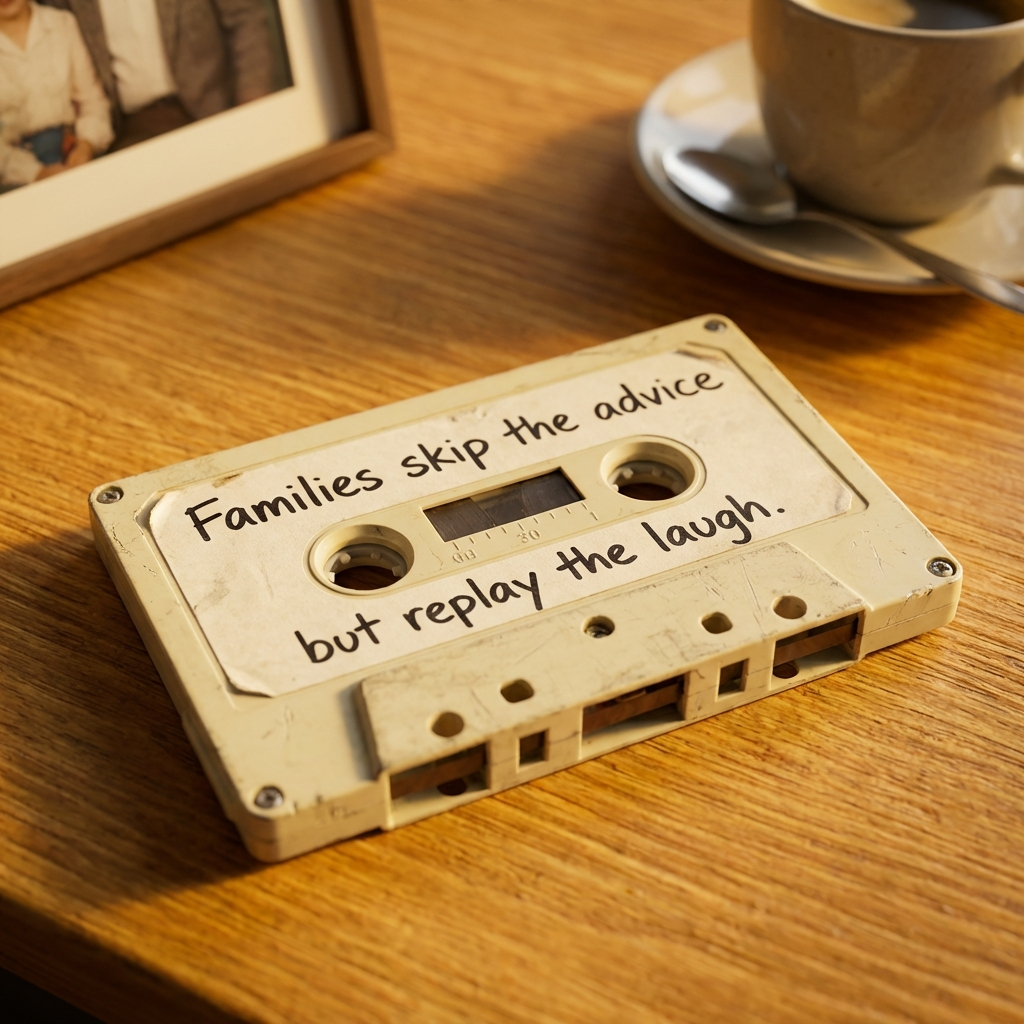
Here’s what I’ve discovered about these recordings—families skip the advice but replay the laugh. They fast-forward through the wisdom but rewind to hear the way someone says their name.
You expect the recipient to focus on your carefully chosen words. What they end up focusing on is the twinkle in your eye, the specific cadence of your voice, the small idiosyncrasies that make you uniquely you.
When RecordMeNow interviewed 100 people who lost a parent before age 16, they asked what these individuals wished their parents had recorded. The single most important thing wasn’t life advice or family history—it was hearing their parent say they were proud of them, that they loved them, and to hear it with their name.
People needed to hear it directly. Not just be told by others that “your mom loved you so much.”
The full emotional bandwidth of communication—facial expressions, tone, gestures—carries information that text will never capture. You’re watching someone on mute right now, you can see they look serious or mysterious, but you’re missing crucial context without the voice.
That’s the problem with text-only preservation. You lose the 80% that comes through body language and vocal presence.
When someone receives one of these complete messages years later, they’re not just getting information. They’re reconnecting with the person’s entire presence.
The Reconciliation Window Closes Permanently
Palliative care nurse Bronnie Ware spent years documenting deathbed regrets. One pattern emerged consistently—people wished they’d had the courage to express their feelings. Many suppressed what they really thought to keep peace with others, settling for mediocrity and never becoming who they were truly capable of becoming.
The most common lament: not saying sorry when they should have, not reconnecting sooner to estranged family members.
I had a friend recently who lost his father to cancer. On his deathbed, his father was saying he was sorry for all that he did. By that time you only have five minutes, maybe one day, and the person is halfway in and halfway out of consciousness.
That’s extremely difficult. But it’s also completely preventable.
There are endless stories like this—from all cycles of life, all cultures. Life naturally causes regret because humans make mistakes, and when you make mistakes with the people you love most, you want to reconcile. You want to make right the unintentionalities that seeped through your flawed character.
Leaving these messages allows for at least some degree of reconciliation before you leave.
The problem is that people lose time rather quickly by taking tomorrow for granted.
Future-Targeted Messages Change Present Behavior
Studies show that people who write to their future selves are more likely to follow through on long-term goals. When you open that letter later, you experience a direct connection with your past self that shows you exactly how far you’ve come, what you’ve forgotten, and what still matters.
Recording messages for future delivery demonstrates you’ve done some thinking about the future. One executive recorded personalized messages for each of his twin children that will express his love around their 18th birthdays and their potential weddings.
This is very different from leaving photos on a phone or a journal behind. It’s an active investment in who they’ll become.
The triggers that prompt these recordings vary in intensity. Sometimes it’s a gentle reminder—a photo that pops up in Google memories bringing back nostalgia and the need to interact with others and somehow share your love.
Sometimes it’s more immediate. I saw a video recently that someone sent me of a man playing a song titled “After I Pass Away.” It was about the broken and strained relationship with his kids, how they didn’t ever come and see him, that they’re the ones that left while he stayed and got gray.
It was so impactful that I immediately wanted to call my family members. The emotional triggers in the song were just that powerful.
That’s what future-facing messages do—they create urgency in the present by making the future feel real and finite.
The Cultural Shift That Needs to Happen
Right now, this practice isn’t normalized. Recording meaningful messages for future delivery feels unusual, maybe even morbid to some people.
But I think the impact is going to be greater once it becomes more collective—once people are doing this frequently, the way they post on Facebook or Instagram. When that happens, people will understand and know the importance of such a platform.
The shift from “interesting concept” to “essential practice” requires reaching critical mass where preserving these meaningful messages becomes as standard as any other form of digital communication.
The challenge is communicating something that seems obvious once you experience it but remains abstract until you do.
At life’s end, patients universally express that all that remains is love and relationships. Many realize they wished they had stayed in touch with friends—they don’t truly realize the full benefits of old friendships until their dying weeks when it’s not always possible to track them down.
Everyone misses their friends when they’re dying. Many had become so caught up in their own lives that they let golden friendships slip by over the years.
You can’t retrieve what you never recorded. You can’t reconcile what you never expressed.
What Are You Waiting For?
The assumption that you’ll have time later is the most dangerous assumption you can make.
You’re treating tomorrow as guaranteed when it’s not. You’re assuming the difficult conversation will be easier next month when it won’t be. You’re believing you’ll find the right moment when the right moment is now.
Future-facing messages work because they force you to confront the reality that time is the only non-renewable resource you have. They create a mechanism to preserve what matters before the reconciliation window closes permanently.
When you record knowing someone will receive it at their wedding, at their graduation, after you’re gone—you speak differently. You strip away the noise and get to what’s real.
You stop performing and start preserving.
What message are you avoiding recording right now? What conversation are you putting off because you assume you’ll have another chance?
Leave a Reply
You must be logged in to post a comment.