Here’s what hospice workers see that most families don’t realize until it’s too late.
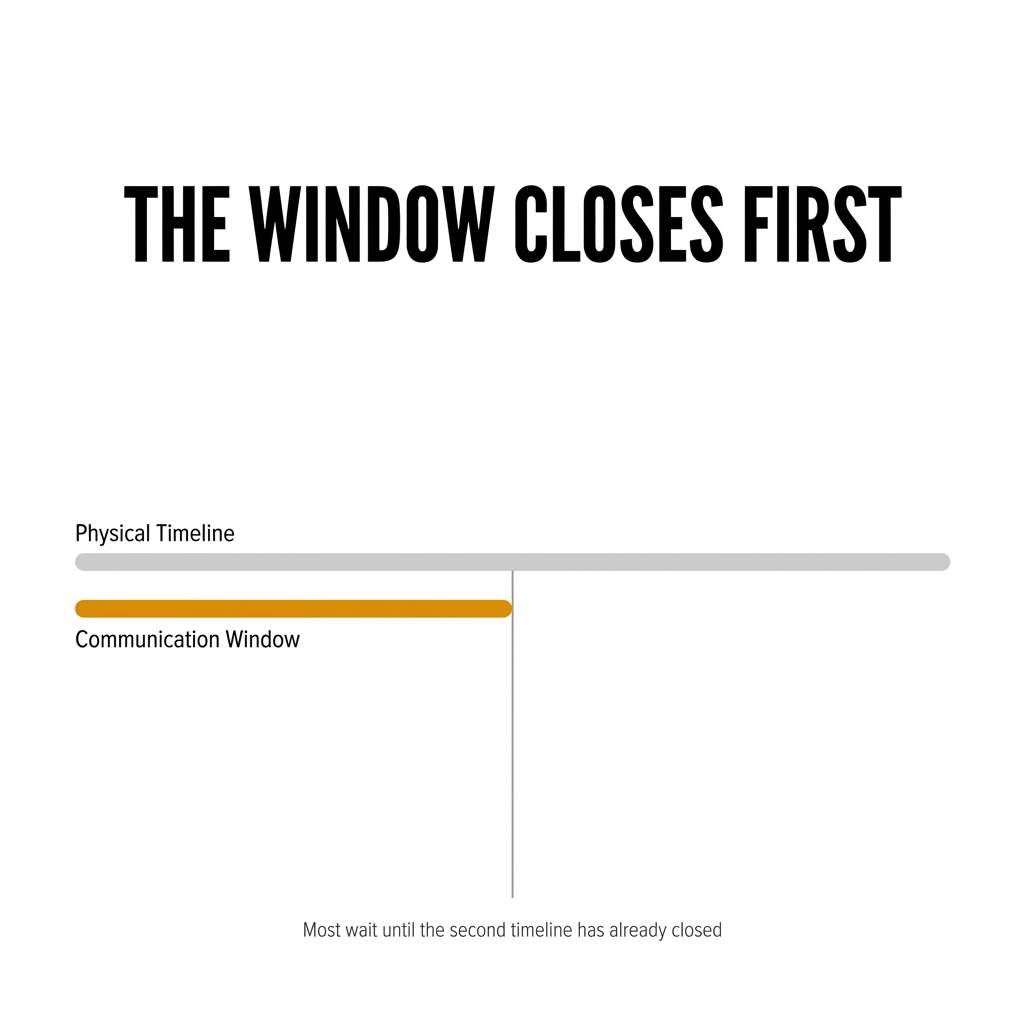
The moment someone receives a terminal diagnosis, two timelines begin. One tracks physical decline. The other tracks the window where meaningful communication remains possible.
The second timeline moves faster.
Research on dementia progression shows patients become unable to understand others or make themselves understood well before the final stages. With cancer, studies document a relatively stable period followed by steep decline in the last one to five months. But the ability to record coherent thoughts, share memories, and express what matters—that window starts closing the day of diagnosis.
The Problem Isn’t Physical Capability
You’d think the barrier to recording legacy messages would be physical decline. Loss of speech. Inability to sit up. Exhaustion from treatment.
That’s not what stops people.
The real barrier is psychological. People get overwhelmed at the possibility of what could be said and how much has been left unsaid. They don’t know where to start. They don’t know the process exists. They’ve never seen it modeled.
And by the time they’re ready to begin, the drugs and painkillers have already narrowed the window.
A study across three European countries found that in the last week of life, 30-40% of patients reported communication difficulties with family members. Only 23% discussed end-of-life issues at all. The conversations that matter most become the hardest to have precisely when they’re most urgent.
Why Real-Time Conversations Fail
Death and dying are the most difficult topics for terminally ill patients and their families to discuss during final stages. Five categories of barriers emerge: emotional, cognitive, communicative, relational, and external processes.
The most frequent? Emotional and cognitive blocks like protective buffering and belief in positive thinking.
Here’s the pattern: Someone gets a terminal diagnosis and suddenly realizes they’ve spent years prioritizing work over relationships. They want their family to reprioritize immediately. But the family has been trained for decades that other things mattered more.
You can’t undo years of relational training in a deathbed conversation.
The dying person has new clarity. The family still operates on the old infrastructure. Real-time conversation requires both parties to be ready simultaneously. That rarely happens.
Time limitations compound the problem. Studies show advance care planning conversations require 22-26 minutes. Many patients are admitted to hospice with only hours or days remaining. The window for meaningful exchange has already closed.
The Mechanism That Removes the Requirement for Reciprocation
Asynchronous video solves what synchronous conversation cannot.
When you record a message that delivers in the future, you remove the requirement for immediate reciprocation. The dying person can do the relational work now. The impact unfolds over years regardless of whether the recipient is ready to receive it in real time.
A father with a damaged relationship can record birthday messages for the next 30 years. Each video arrives precisely when he designated it. The daughter receives them whether she’s ready for reconciliation or not.
The effort spent creating videos can soften hearts that couldn’t soften during deathbed conversations.
Research confirms this mechanism works. Studies show a higher degree of open communication about death is associated with less bereavement distress for relatives. But that communication doesn’t have to happen in real time to be effective.
The concept of legacy assumes most people want to feel their life had meaning and that it will endure. That desire intensifies as death approaches. Video messages with personal content carry different weight than spoken words—even if the same things have been said before, writing them down or recording them lends new significance.
What Gets Lost Without This
I’ve had multiple conversations with people who expressed regret that this platform wasn’t available sooner. Especially during COVID.
The regret isn’t just about missing someone’s voice. It’s about losing facial gestures, emotions, the full presence of a person. It’s about realizing too late that you never captured what mattered.
Hospice chaplains report that reconciling people before they die consumes a large portion of their work. Regrets naturally surface at the end of life because people want to close their narratives. They’re reflecting on everything they’ve lived.
One of the most common end-of-life regrets is not spending enough time with loved ones.
Sometimes unexpected loss prevents saying important things before someone passes. You’re left with lifelong regrets, wondering “what if I had a chance to say goodbye?”
The platform I built—iLoveView—exists because I had a dream in December 2015. I saw myself recording a video on my phone, setting a future date, and watching a countdown mechanism. When I woke up, I knew it was feasible but unrealistic given my resources.
It took five years to build the first version. During that gap, I didn’t record anything else for my family because I knew the videos would be trapped on my machine with no reliable way to deliver them.
Who This Actually Serves
The platform works for anyone facing temporal constraint or relational severance.
Terminal patients who want to leave wisdom, stories, and love for children who aren’t ready to receive it yet. Parents deploying overseas who need to send birthday messages home. Coaches who want to deliver motivation to athletes at precise future moments. Business leaders who want continuity without constant availability.
But the hospice market represents the most acute pain point. These are people who realize their time is finite and suddenly understand what actually mattered.
The problem is that realization often comes too late.
I’ve shared the concept with terminal patients and their families in these early stages. Some were waiting for a stable version. Others weren’t engaged enough to see the value of leaving legacy behind.
That’s the tension: the dying person might want to leave something, but the family has to value receiving it. Sometimes the awareness gap prevents the very preservation that would matter most later.
The Job That Doesn’t Exist Yet
Someone mentioned to me that this could create a job market. Professional legacy interviewers who go to senior living facilities and engage people in recorded conversations.
Old people want to talk. They’re just not engaged enough. They feel unheard, lonely, left out, disinterested because the world is too busy.
Someone could ask about World War II, Vietnam, a long-lost love. The stories are there. The willingness to share is there. What’s missing is someone to initiate the conversation and capture it before the transmission window closes.
With enough exposure, this becomes part of daily or weekly routine rather than a crisis response.
People wouldn’t have to wait for a terminal diagnosis. They could be recording videos and sending them to the future as normal practice. The hospice demographic just happens to have the most acute pain points and should provide initial exposure.
What the Research Shows About Legacy
More people are filming videos of themselves to be shown after death. These can be powerful ways to say goodbye and leave lasting video legacy.
The majority of relatives of patients with advanced cancer experience open discussions about illness and death during the last three months of life. Higher degrees of open communication correlate with less bereavement distress.
But honest and timely communication requires time that terminal patients often don’t have. Patients in the terminal phase frequently struggle to communicate, leaving relatives to make decisions without clear information.
Asynchronous video gives relatives time to say goodbye and improves psychological outcomes by removing the pressure of real-time emotional negotiation.
The patient usually knows they’re dying. It takes enormous energy to maintain the lie rather than sit in uncomfortable truth. When patients know they have weeks or months or days left, that knowledge informs how they live in the present moment.
If you avoid and deny this reality, you miss powerful opportunities to capture what matters before the window closes permanently.
Why the Window Matters More Than You Think
As dementia progresses, people experience reduced or lost verbal communication abilities. Cognitive capacities decrease. Patients become lethargic, confused, disoriented, or unresponsive.
The decline happens faster than families expect.
With cancer, the trajectory shows stability followed by acute decline in the final months. Studies support this pattern, though the timing of steep decline ranges from one to five months before death.
The transmission window—the period where someone has both awareness of what matters and capacity to communicate it—is shorter than the physical decline timeline.
Fear of facing death creates barriers. Some patients associate these conversations with imminent death or feel scared and not open to talking about dying. Communication barriers exist at all disease stages but become more frequent and difficult as illness progresses.
The longer you wait, the narrower the window becomes.
What Actually Happens When You Record
I’ve uploaded photos from family albums, created narrated videos, and sent them to the future. The platform allows live recording or uploading previously captured content.
You can target specific people. Set specific dates. Create videos that populate at certain frequencies—weekly, monthly, annually—for as long as you designate.
Recipients receive notifications and thumbnails but cannot open the videos until the time you designated arrives. That’s the mechanism that removes pressure and interference from real-time emotional dynamics.
Even if reconciliation doesn’t happen as quickly as you want, the effort you spend preserving time can eventually soften hearts.
The platform doesn’t replace in-person communication. It preserves what matters when in-person communication isn’t possible or productive. It removes the requirement that both parties be emotionally ready simultaneously.
The Question You Need to Answer Now
If you knew someone had weeks or months left, what would you want them to record?
If you were the one with limited time, what would you want preserved for the people you love?
The transmission window is open right now. It won’t stay open forever.
The people who wait for the perfect moment to start recording usually wait until the window has already closed.
You can’t recover lost time. You can’t recreate conversations that never happened. You can’t retrieve voices that were never captured.
What you can do is recognize that time is finite and act accordingly while the window remains open.
This is why iLoveView
Leave a Reply
You must be logged in to post a comment.