A mother with terminal cancer spent her final months recording videos for her children.
Not farewell videos. Future videos.
Graduation day. Twenty-first birthday. Wedding morning. The birth of her first grandchild.
She sat in front of a camera while she still had the strength and clarity to speak, and she recorded what she wanted her children to hear when those moments arrived—years, maybe decades later.
Her daughter later said: “It was so comforting knowing that she still had some wisdom for us for those seasons.”
The videos didn’t just preserve her voice. They preserved her presence in the moments she knew she’d miss.
What People Actually Say When They Know Time Is Running Out
I’ve sat with people in hospice. I’ve watched families gather around hospital beds, trying to capture everything before it’s too late.
What strikes me is what people don’t talk about.
They don’t talk about dying. They don’t deliver grand philosophical statements about the meaning of life.
They talk about how they feel about each other. They share the most wonderful times of their lives. They tell stories that only they can tell—the context that makes a family understand who they are.
Kate Carter, who has facilitated over 120 legacy video sessions through LifeChronicles, observed the same pattern: “Usually people don’t talk about dying. They talk about how they feel about each other.”
The urgency isn’t about documenting facts. It’s about preserving connection.
The Problem With Waiting Until the End
I remember sitting with an elderly woman in her final days. She kept reaching for her daughter’s hand, trying to share family stories—names, dates, places that only she knew.
Her daughter frantically scribbled notes, trying to capture everything.
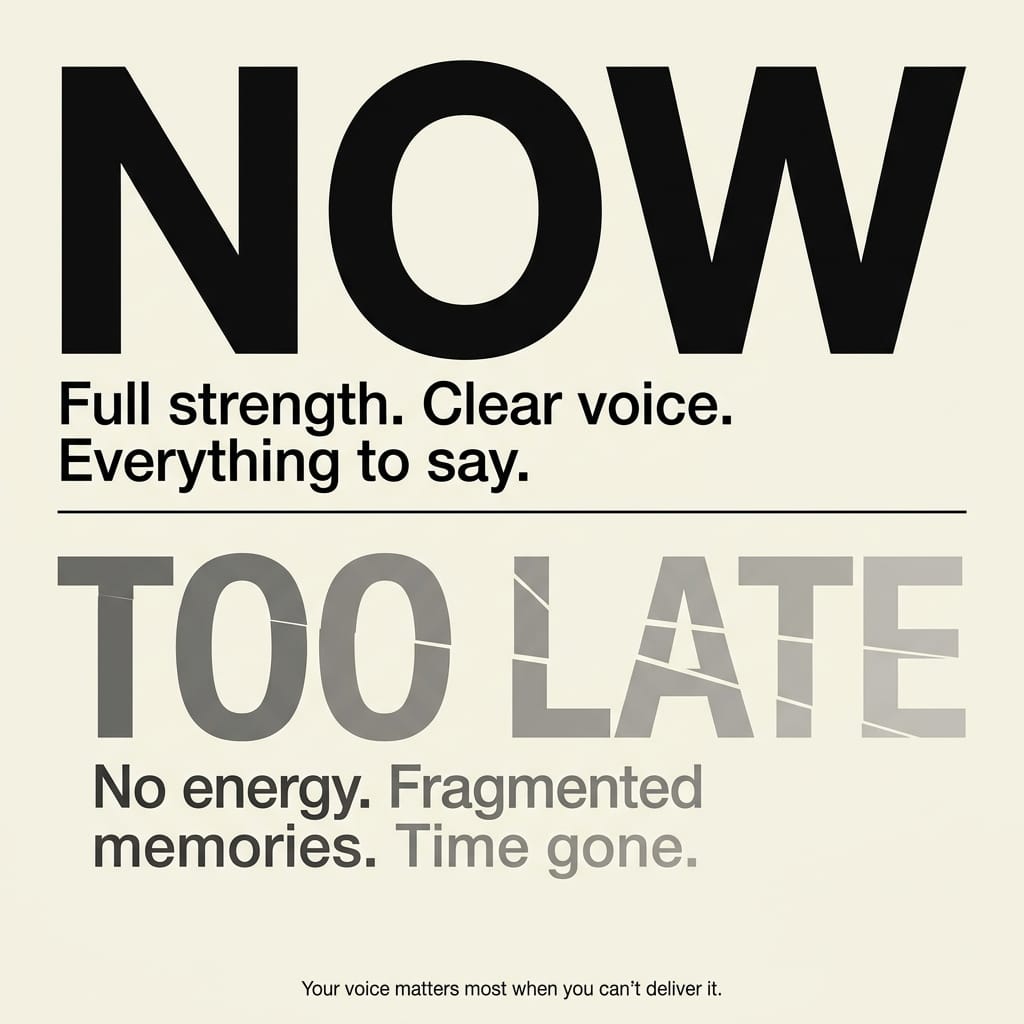
But the woman was so weak. The moments were fragmented. There just wasn’t enough time or energy left.
What haunted me was watching her struggle to share decades of wisdom and love when she could barely speak.
By the time most people realize they need to preserve these messages, they’re already running out of strength to deliver them.
A social worker at Pomona Valley Hospital Medical Center put it this way: “People in the past have left letters and birthday cards for their children, but there is so much more impact with seeing the parent on film.”
Written words can’t capture tone. They can’t show expression. They can’t let your children hear your voice years after you’re gone.
When I Started Recording My Own Messages
I drove trucks for years. Long haul. Different time zones. Weeks away from home.
I missed birthdays. Christmas. Holidays. Soccer games. All of it sacrificed for work.
The moment that broke me was missing my son’s graduation awards ceremony.
I started recording videos on my own after that. Just in case there was never a tomorrow.
I said everything that needed to be said. I shared my values, what I hoped for their futures, lessons I’d learned that might help them. I wanted to capture the family stories that only I could tell—the kind of things that give context to who we are.
I stored them on my computer with instructions left with people who would follow through with my requests.
It wasn’t a platform. It wasn’t a system. It was just a father trying to make sure his voice would still be there if he wasn’t.
What Ministry Taught Me About Last Words
I transitioned into ministry gradually over five years. Started taking theology courses while still driving. Got ordained in 2019. Now I serve full-time as a pastor with a broad reach—hospice, prison chaplaincy, people breaking addiction, deliverance work.
Being with people in their final days completely transformed how I thought about those videos I’d been recording.
I realized that what people need at the end isn’t motivational content or self-help tips.
They need genuine presence, honest conversations about meaning, and someone who isn’t afraid to sit with them in their pain and uncertainty.
And they need a way to give that same presence to the people they love—even after they’re gone.
The Father Who Thought He Had Two Months
Jon Loew faced what he thought was terminal illness. His kids were 8 and 6.
His first thought: “I’m going to be dead in two months and my kids are 8 and 6. Who’s going to guide them? What questions will they have when they’re older?”
So he started recording videos—answering questions he thought his children might one day have about life, work, marriage, and parenting.
Messages designed for specific future moments when they’d need his voice most.
Another mother battling metastatic cancer, Ginger Johnson, said it perfectly: “Traditional journaling is great, and capturing photos of special events is helpful. However, they cannot replace the ability to listen, see, and hear someone you love express their true desires and feelings about you. That means so much—to be seen and heard and loved. Even after you are gone.”
The Video No One Was Supposed to See
A mother suffering with cancer recorded a video for her two sons. She didn’t tell them about it.
Then she beat the cancer.
Years later, she passed away unexpectedly in 2024. The boys were told about the video for the first time.
Her son said: “This is the best news I’ve heard since Mom passed.”
The video became a time capsule. A bridge across the distance that death creates.
Her voice arrived exactly when they needed it most.
Why I Built iLoveView
I knew people needed this. I’d witnessed it in hospice rooms. I’d lived it as a father on the road. I’d felt the urgency in my own chest.
So I started building.
I taught myself basic web development at night while working my day job. Started on WordPress, had it customized. No funding. No co-founder. Just a clear vision and about six months of savings.
The first version had glitches. The second version had fewer glitches but weak security.
Then I spent tens of thousands on a custom WordPress solution. After a year of investment and process, the developers told me they couldn’t continue because of the limitations of the tech.
So I hired another company. They offered a price tremendously lower than any other fully custom code offer I’d ever had.
They were a scam. They took me for several thousand dollars.
Two massive failures, back to back. I set the platform on the shelf for over a year.
Then one day I was experimenting with an AI site simulator—you could give it prompts and it would create the UI/UX. It created the interface decently, but there was no backend.
That’s when I found the developer I’m currently working with. Someone who fully saw the vision and the power behind what could be done.
The platform is ready now. The vision is clear.
What This Actually Solves
You can’t interrupt a video message. You can’t argue with it. You can’t defend yourself or shut down when it gets uncomfortable.
You have to listen.
That’s the power of asynchronous communication when it comes to the messages that matter most.
Real-time conversation gets hijacked by emotion, interruption, and defensiveness. But a recorded message creates space for authenticity without interference.
People don’t need another social media feed. They don’t need another platform optimized for engagement and addiction.
They need a way to be heard by the people they love before it’s too late.
Digital legacy platforms now function like time capsules—dispensing prerecorded messages at significant times or dates in the future. A grandchild’s 16th birthday. A child’s wedding day. The moment they need to hear your voice most.
The Urgency You Don’t Feel Until It’s Gone
The people you love won’t be here forever.
You know that intellectually. But you don’t feel the urgency until you’re sitting in a hospital room, watching someone struggle to say what they should have said years ago.
I spent a decade building a solution to a problem most people don’t realize they have until it’s too late.
Now I’m making them realize it in time.
Because the alternative is watching your children frantically scribble notes while you reach for their hand, trying to share everything that matters when you can barely speak.
The alternative is leaving words unsaid, stories untold, and wisdom unshared.
The alternative is your voice disappearing when the people you love need it most.
You still have time. You still have clarity. You still have strength.
What are you waiting for?
Leave a Reply
You must be logged in to post a comment.