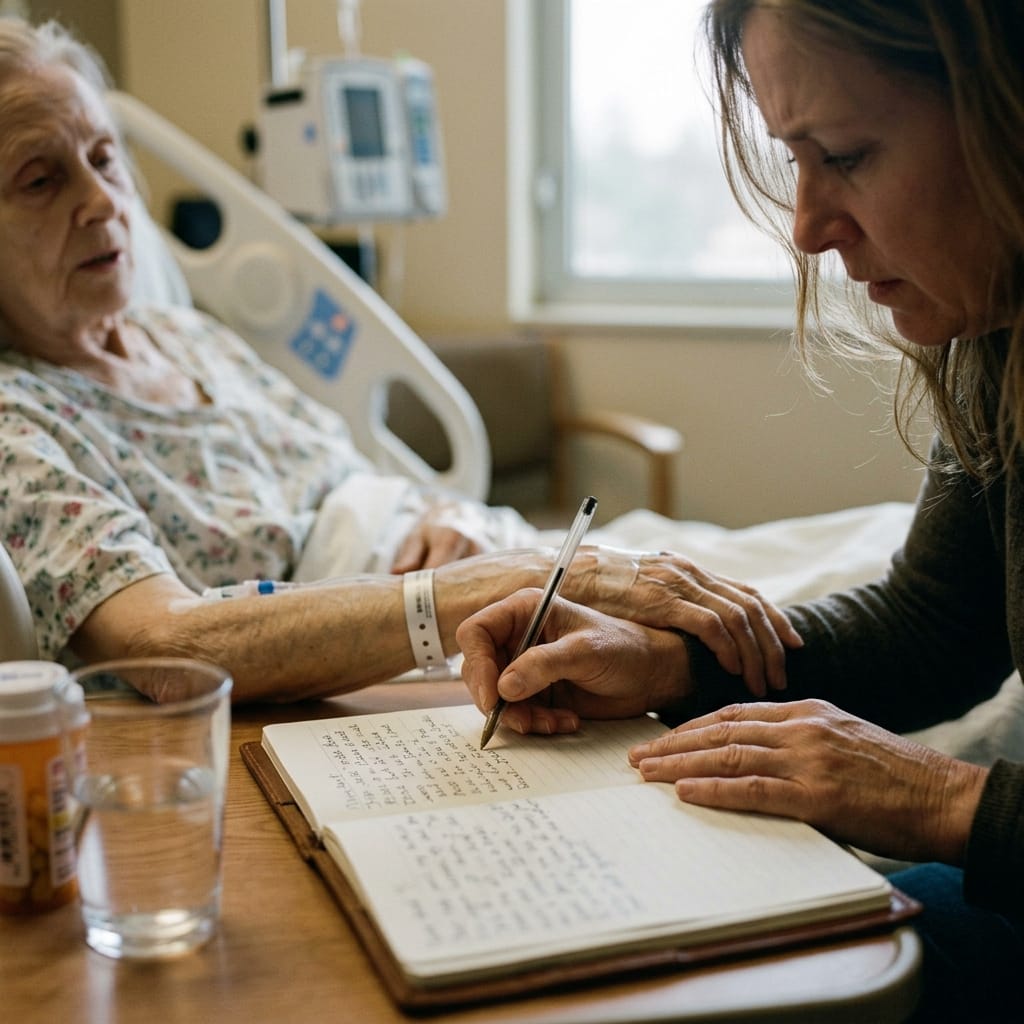
I sat with an elderly woman in hospice who kept reaching for her daughter’s hand. She was trying to tell stories about their family history. Names, dates, places that only she knew.
Her daughter frantically wrote everything down, but mom was so weak and the moments were so fragmented. What haunted me most was watching her struggle to share decades of wisdom and love when there just wasn’t enough time or energy left.
That scene replays in my mind every time I hear about someone like the mother who spent her final months of clarity recording messages for her children’s futures. Graduations. Weddings. First heartbreaks. Her voice will arrive exactly when needed, decades from now.
She understood something most people don’t realize until it’s too late.
The Math of Childhood Grief Nobody Talks About
An estimated 6 million children in the U.S. will experience the death of a parent or sibling by age 18. More than 1,000 U.S. children lose a parent or sibling every single day.
The numbers are staggering, but they don’t capture what actually happens to these kids.
Children who lose a parent are more than twice as likely as non-bereaved kids to show impairments in functioning at school and at home. Not just immediately after the loss. Seven years later, according to the longest and most detailed study of pediatric grief following parental loss to date.
The death of a parent is consistently rated as one of the most stressful life events a child can experience. Most children’s grief reactions fade over time, but a subset shows increased or prolonged grief reactions. That prolonged grief increases the risk for functional impairment and depression.
Here’s what makes it worse: 57% of those who lost a parent during childhood report that support from family and friends waned within 3 months. It took an average of six years to move forward.
The world moves on. The grief doesn’t.
What Gets Lost When We Wait
I missed my son’s graduation awards ceremony because I was driving a truck across the country. That moment still sticks with me years later.
I started recording videos on my own after that, just in case there was never a tomorrow. I stored them on my computer with instructions left with people who would follow through with my requests.
I focused on sharing my values and what mattered most to me. What I hoped for their futures. Lessons I’d learned that might help them. Making sure they knew how proud I was of them. I wanted to capture family stories and memories that only I could tell, the kind of things that give context to who we are as a family.
It wasn’t about any single topic. It was about leaving them with a sense of connection and understanding of what guided my life.
But I was doing it wrong.
Recording random videos on your computer isn’t a system. It’s a hope. You hope someone finds them. You hope they’re delivered at the right time. You hope the technology doesn’t fail. You hope your instructions are followed.
The woman in hospice didn’t have that luxury. She was trying to compress a lifetime of wisdom into fragmented moments when her body was already shutting down.
The Difference Between Recording and Preserving
Legacy videos and audio recordings are powerful tools for capturing a loved one’s voice and messages for generations to come. These recordings turn into poignant memorials that enable families to revisit cherished memories long after their loved ones have passed.
But there’s a difference between recording something and preserving it with intention.
Recording is what you do when you think about it. Preserving is what you do when you recognize time as the only irretrievable resource.
The terminal cancer patient who recorded messages for her children’s futures understood this. She wasn’t just talking into a camera hoping someone would find the files someday. She was creating a structured system where her voice would arrive exactly when her children needed it most.
First day of high school. College acceptance. Wedding day. The birth of their first child.
She won’t be there physically. But her voice will be.
Why Early Communication Matters
Talking openly and honestly soon after finding out cancer is terminal can help give children time to absorb the news and ask questions. Being included in this difficult transition helps children feel reassured.
But here’s what the research doesn’t tell you: those early conversations are just the beginning.
Communication is considered a protective factor for parentally bereaved children’s psychological health. Brief interventions lead to reported improvements in communication and family relationships.
The problem is that most families have one big conversation and then stop. They think they’ve addressed it. They think the kids know they’re loved. They think the important things have been said.
But children don’t process grief like adults. They revisit it at different developmental stages. The questions a seven-year-old has about death are different from the questions a teenager has. The comfort a college student needs is different from what they needed at the funeral.
One woman received a voice message of her mother singing “Happy Birthday” before she knew how bad her mother’s cancer was. Three years later, she listens to the recording on her cell phone on her birthday every year. She’s backed it up, just in case she loses the phone or something unexpected happens.
That’s not grief work. That’s connection across time.
What I Learned Sitting With the Dying
I transitioned from truck driver to ordained ministry over about five years. I started taking theology courses while still driving, got ordained in 2019, and now serve full-time as a pastor with broad reach including hospice, prison chaplaincy, people breaking addiction, and even deliverance.
Being with people in their final days completely transformed my perspective on those early videos I’d been recording.
What people need at the end isn’t motivational content or self-help tips. They need genuine presence. Honest conversations about meaning. Someone who isn’t afraid to sit with them in their pain and uncertainty.
But what they want most is time they no longer have.
Time to say what needs to be said. Time to share what only they know. Time to be present for the moments they’ll miss.
Legacy letters play a crucial role in end-of-life care by allowing individuals to express their feelings, share their life experiences, and offer words of wisdom to their loved ones. These letters provide comfort, guidance, and a sense of connection to the writer long after they have passed away.
Recording messages in advance allows parents to be there for their children at significant moments of their lives. Leaving not just money behind, but words of wisdom. A way to have future conversations they will never have the chance to have in person.
The Technology That Failed Me Twice
I knew this needed to exist, but I didn’t know how to build it.
I spent several tens of thousands to get a version of the platform on WordPress with customization on the plugins. After a year of investment, time, and process, they could continue no further because of the limitations of the tech.
Then I hired another company that said they would customize it from scratch. They offered me a price tremendously lower than any other fully custom code offer I had ever had.
They were a scam. They took me for several grand.
Both of these challenges, back to back, ended with me setting the platform on the shelf for over a year.
But the vision didn’t die. I kept seeing that woman in hospice reaching for her daughter’s hand. I kept thinking about my son’s graduation ceremony. I kept watching people run out of time.
One day I experimented with an AI site simulator that could create the UI/UX from prompts. It had no backend, but it reignited something. I found the developer I’m currently working with who fully saw the vision and the power behind what could be done.
The platform exists now. But it took seven years of waiting for the technology to catch up to what I knew needed to be real.
What 81% of People Experience After Loss
81% of participants who experienced contact with deceased loved ones reported that the experience brought them comfort or emotional healing. 84% considered it important. Most people described these connections as healing and affirming.
This isn’t about ghosts or supernatural experiences. This is about the human need to maintain connection with people we’ve lost.
A voice message. A video recording. A letter written years before but opened at exactly the right moment.
These aren’t substitutes for presence. They’re bridges across time.
Legacy work describes something of value that can outlast death, help people decide how they want to be remembered, support dignity, and strengthen connection across generations. The primary goal is to help individuals express their identities, share their life lessons, and leave behind something meaningful for their families and future generations.
The terminal cancer patient who recorded messages for her children’s futures wasn’t trying to cheat death. She was trying to honor time.
The Question You’re Not Asking
You’re reading this and thinking about someone else. Someone who’s sick. Someone who’s older. Someone who needs to record these messages before it’s too late.
You’re not thinking about yourself.
I wasn’t either until I missed that graduation ceremony. Until I started driving trucks and realized I was losing connection with the people who mattered most. Until I sat with enough dying people to understand that “someday” is a lie we tell ourselves.
The people you love won’t be here forever. Neither will you.
What are you waiting for?
Leave a Reply
You must be logged in to post a comment.