
73% of bereaved families report unfinished business after losing someone to terminal illness.
That statistic comes from a study tracking families through cancer bereavement. The most common regret wasn’t about medical decisions or funeral arrangements.
It was not having the conversation about end-of-life while there was still time.
Here’s what the research won’t tell you: the transmission window closes faster than you think. For terminal patients, the median remaining lifetime is 55 days. 37% die within the first month of that timeline.
You’re not procrastinating because you’re busy. You’re procrastinating because recording what matters forces you to confront uncomfortable truths about yourself and your relationships.
I know this because I’ve spent decades in ministry watching people break down when they realize they’re out of time. I know this because I drove a semi truck for years, away from home three weeks at a time, recording videos for my son that I couldn’t send the way I needed to.
And I know this because I built iLoveView specifically to solve the problem that almost no one wants to admit exists: we don’t have a infrastructure problem with preserving memories. We have a courage problem with saying what needs to be said.
The Interference Principle
Real-time communication fails because you’re managing two jobs simultaneously.
You’re trying to express your authentic thoughts while also monitoring the other person’s emotional reactions, managing their interruptions, and navigating the conversational friction that emerges when someone hears something they don’t want to hear.
This is why the most important conversations never happen. You’re not just facing time scarcity. You’re facing emotional interference that corrupts the signal before it reaches the other person.
Video solves this in a way that text messages, letters, and even audio recordings cannot. When someone sees your face, your expressions, your eyes as you speak, there’s almost no room for misinterpretation of intent or emotion. They can’t read their own assumptions into your words the way they do with text.
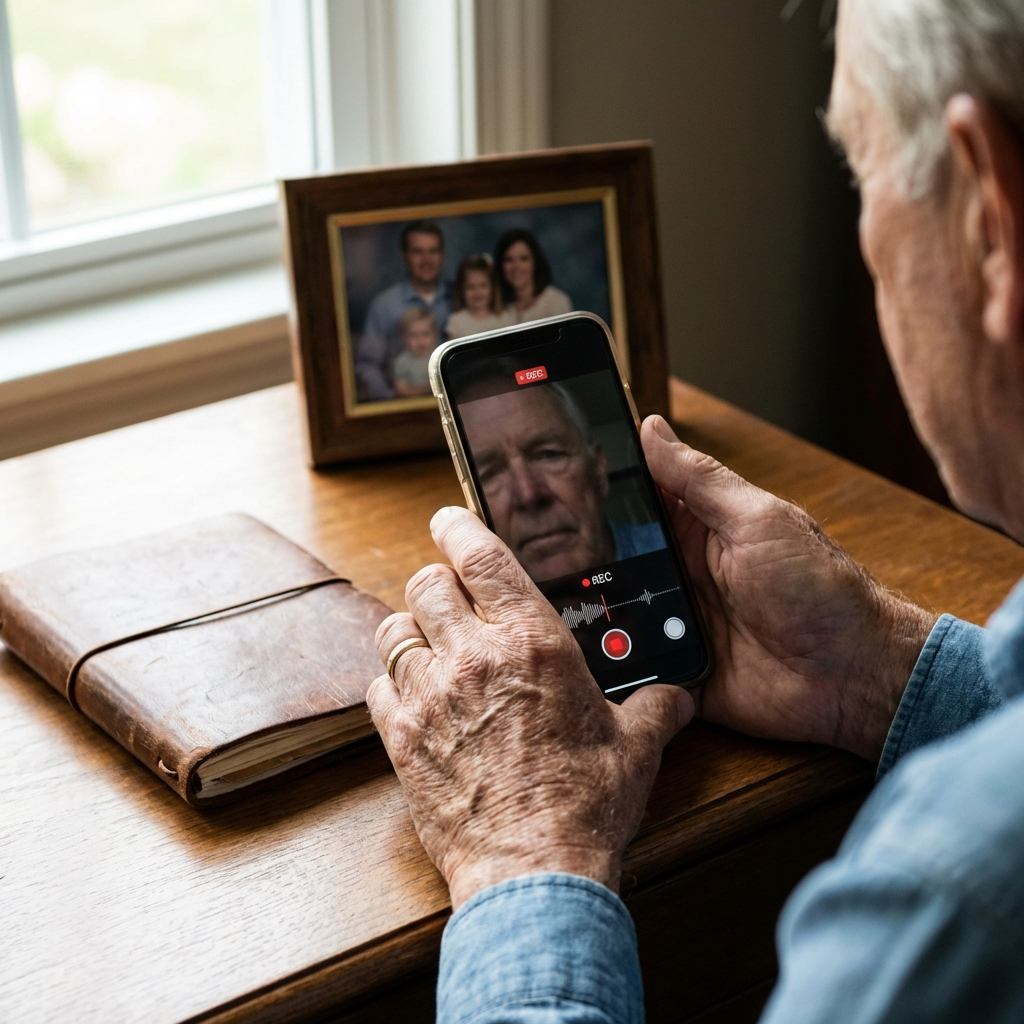
But you still have to hit record. And that requires knowing what actually matters enough to preserve.
The Five Message Categories That Survive You
After working with families facing separation through terminal illness, military deployment, divorce, and occupational displacement, I’ve identified five categories of messages that people consistently wish they had captured.
These aren’t sentimental categories. They’re structural. They address specific relational voids that synchronous communication consistently fails to fill.
1. Milestone Messages
These are the messages for events you won’t attend.
Graduations. Weddings. The birth of grandchildren. Career achievements. Moments when your absence will be felt most acutely.
The power isn’t in generic congratulations. The power is in speaking directly to that specific moment with knowledge of who that person is becoming. Your daughter’s wedding isn’t just “I’m proud of you.” It’s what you know about her capacity for love, what you’ve observed about how she builds relationships, what you hope she carries forward.
These messages work because they arrive at the exact moment when your voice matters most. Not six months before. Not through a letter someone else reads. Your face, your voice, speaking directly into that experience.
2. Origin Stories
These are the stories that explain where someone came from.
Not the sanitized family history. The real story. Why you made the choices you made. What you were thinking during the moments that shaped your family’s trajectory. The context that gets lost when you’re not there to provide it.
I have a son from a previous marriage. Due to circumstances and misunderstandings, he didn’t spend as much time with me during his high school years as he could have. I’ve created videos explaining who I am, what our life was like, what I was trying to do even when it didn’t work out the way I hoped.
Not because I need him to agree with my choices. Because he deserves to know the truth without it being filtered through other people’s interpretations or his own incomplete memories.
These messages preserve the actual story before it gets rewritten by time and other people’s narratives.
3. Practical Wisdom
These are the messages that transfer knowledge you’ve earned through experience.
Not advice. Wisdom. The difference between “work hard” and “here’s what I learned about navigating workplace politics after twenty years in that industry.” The difference between “be careful with money” and “here’s the specific financial mistake I made at 35 and why it cost me a decade of recovery.”
Senior citizens hold decades of accumulated wisdom that dies with them because we treat legacy work as nostalgia instead of knowledge transfer. Recipes. Traditions. Secrets about family history. Even practical information like passwords to accounts or locations of important documents.
One person could record a treasure map to hidden wealth and set it to deliver 25 years in the future. Another could record the story behind a family tradition so grandchildren understand why it matters.
This isn’t about preserving the past. It’s about equipping the future with information they’ll need when you’re not there to provide it.
4. Unfinished Business
These are the messages that address what’s broken.
Apologies you never made. Explanations for decisions that hurt someone. Acknowledgment of your failures as a parent, spouse, or friend. The truth about situations where misunderstanding created permanent distance.
Research shows that unfinished business causes lasting psychological damage after bereavement. When people have meaningful conversations about end-of-life decisions and unresolved issues, survivors report less guilt, less distress, and healthier grieving processes.
But terminal illness creates communication barriers. Family members avoid discussing the illness to protect the patient. Patients withhold their fears to protect family members. This mutual protection creates exactly what everyone fears most: separation without resolution.
Recording these messages removes the real-time emotional interference. You can say what needs to be said without managing someone’s immediate reaction. They can receive it when they’re ready to hear it, not when you happen to have the courage to speak.
This is reconciliation work. It requires acknowledging the severity of relational damage without the buffer of “we’ll talk about it later.”
5. Permission
These are the messages that release people from obligations they think they owe you.
Permission to move on. Permission to make different choices than you would have made. Permission to stop carrying guilt about decisions that disappointed you. Permission to live their own life without constantly wondering what you would think.
This category gets overlooked because we assume people know they have permission. They don’t. Especially when you’re gone and can’t explicitly release them from expectations you may have never actually held.
These messages work because they eliminate years of unnecessary psychological burden. Your adult children don’t have to guess whether you’d approve of their career change. Your spouse doesn’t have to wonder if you’d want them to remarry. Your estranged family member doesn’t have to carry uncertainty about whether reconciliation was possible.
You give them clarity. You give them freedom. You give them your explicit release from whatever they think they owe you.
Why the Legacy Industry Got It Backwards
The legacy industry treats voice preservation as nostalgic storytelling.
They position it as a nice thing to do for future generations. A way to capture family history. A sentimental project for when you have time.
That framing kills urgency. It turns essential communication into optional hobby work.
Here’s what they’re missing: this isn’t about preserving the past. It’s about equipping the future with what they’ll need when you’re not there to provide it. It’s about reconciliation work that can’t happen in real-time because emotional interference corrupts the message.
The median remaining lifetime for terminal patients is 55 days. For non-cancer terminal illness, it’s 17 days. Physicians consistently overestimate survival time, so when someone is expected to live six weeks, they typically die around four weeks.
You don’t have as much time as you think you do. And even if you’re not facing terminal illness right now, you’re facing something else: occupational displacement, geographical separation, relational estrangement, or just the daily erosion of connection that happens when life gets busy and tomorrow always seems guaranteed.
The transmission window is closing whether you acknowledge it or not.
The Technical Barrier Is a Psychological Shield
People tell me they’re not recording because they don’t know what to say or they’re waiting for better lighting or they want to organize their thoughts first.
That’s not what’s actually happening.
You know what to say. You’ve known for years. The lighting is fine. Your thoughts are as organized as they’re going to get.
What you’re actually avoiding is the emotional confrontation that happens when you sit down and force yourself to be authentic about uncomfortable truths. It’s easier to deflect, to say you’ll do it later, to hope you never have to get that real with yourself.
Intellectually, you understand the need. Emotionally, you’re protecting yourself from the discomfort of vulnerability, the fear of conflict, the pride that doesn’t want to admit failure or apologize for harm you caused.
Recording forces you to confront what you’ve been avoiding in real-time conversations. There’s no interruption to save you. No conversational pivot to redirect the topic. No other person’s reaction to manage instead of your own truth.
It’s just you and the camera and the message you’ve been carrying.
That’s why perfectionism shows up. It’s not about getting it right. It’s about having an excuse to delay.
What Happens When You Actually Do This
I’ve been recording messages for my son for years now. Some are scheduled to deliver next month. Some next year. Some years from now.
What’s changed isn’t his understanding of me yet. Most of those messages haven’t been delivered. What’s changed is my peace.
I’ve said what I needed to say. I’ve made my peace. I’ve expressed my feelings in a format where there’s no room for doubt or misinterpretation about who I am and what I was trying to do.
It’s not a text message that can be misunderstood. It’s not a letter where someone can read their own assumptions into the emotion behind the words. It’s not even audio where you hear the words but miss the facial expressions that communicate intent.
It’s video. My face. My expressions. My eyes. The full context of authentic communication without the interference of real-time emotional management.
That’s what this platform does. It removes the excuse. It eliminates the interference. It preserves the message in a format that survives you and arrives exactly when it matters most.
But you still have to hit record.
The Question You’re Avoiding
If you died tomorrow, what would the people you love wish you had said?
Not generic “I love you” statements. The specific truths they need to hear. The explanations for decisions that hurt them. The acknowledgment of your failures. The permission to move on. The wisdom you’ve earned that dies with you if you don’t transfer it.
You already know what those messages are. You’ve known for years. The only question is whether you’ll record them before the window closes or whether you’ll keep believing tomorrow is guaranteed.
What are you waiting for?
iLoveView Now | i Love You Forever
Leave a Reply
You must be logged in to post a comment.