I’m watching the History Channel right now with the sound off.
The guy on screen looks serious. Mysterious. His body language tells me something important is happening, but without his voice, I’m missing the entire point.
That’s what we’re doing with the people we love. We’re watching them on mute and assuming we’ll decode the meaning later.
Here’s the asymmetry that should bother you: You have hours of podcasts saved from people you’ll never meet. Thousands of photos of food you’ll never eat again. Entire playlists curated by algorithms that know your mood better than your family does.
But most of you have zero intentional recordings of the people who actually shaped you.
Not your grandmother’s voice explaining why she does that thing with her hands when she’s nervous. Not your father’s specific laugh when something genuinely surprises him. Not your kid saying your name in that particular way they do right now, at this exact age, before their voice changes forever.
The people you’d give anything to hear again? You’re assuming they’ll be available tomorrow.
The Grief Tax Nobody Warns You About
I had a friend who recently lost his father to cancer.
On his deathbed, his father kept saying he was sorry. For everything. For all the years of mistakes, the unintentional wounds, the character flaws that seeped through despite his best intentions.
He had maybe five minutes of consciousness left. Maybe one day if they were lucky.
Halfway in, halfway out. Trying to reconcile decades of regret in the space between breaths.
That’s the grief tax. The desperate scramble families go through trying to reconstruct what could have been recorded. The frantic search through old voicemails. The pleading with phone companies to recover deleted messages. The bargaining with God for just one more conversation.
You know what people don’t do in those moments? They don’t replay the advice. They don’t analyze the wisdom. They don’t study the life lessons.
They replay the laugh. The way that person said their name. The twinkle in their eye when they were about to tell a terrible joke. The specific gesture they made with their hands when they were explaining something they cared about.
Those small idiosyncrasies that make a person uniquely them. Like a fingerprint, but made of sound and movement and expression.
We are all individuals with our own character habits and traits. The words matter, but many times it’s the smallest things that make you remember.
The Real-Time Interference Problem
Here’s what I’ve learned after decades of ministry work, sitting with people at their breaking points: Face-to-face conversation is often the worst environment for authentic expression.
You want to tell your father you forgive him. But the moment you start talking, his defensiveness kicks in. He interrupts. He rebuts. He turns your attempt at reconciliation into another argument about who was right.
You want to tell your daughter how proud you are of her. But she’s scrolling through her phone, half-listening, and your timing is off, and the moment evaporates before it even begins.
Synchronous communication creates interference. Real-time feedback loops corrupt the signal. The immediate reaction, the potential for interruption, the fear of judgment – all of it distorts what you’re actually trying to say.
That’s why people write letters they never send. Why they rehearse conversations in the shower. Why the most important things often go unsaid until it’s too late.
When you remove the immediate reaction, something shifts. You can express what actually needs to be said. You can speak freely because you know it won’t be interrupted, rebuttaled, or rebuked in real time. There’s a free flow that’s impossible when someone is staring at you, waiting for their turn to respond.
You can leave messages of love. Of regret. Of things you should have said years ago but couldn’t find the words for when they were standing right in front of you.
Why Video Changes Everything
Apple recently released a “send later” feature for text messages. It’s fantastic for reminders and logistics.
But what if you need something more impactful? More meaningful? Something with not only text and characters and capitalizations, but the emphasis of the gestures of your face?
Eighty percent of communication is body language. That’s not motivational fluff. That’s observable reality.
When you strip away the facial expressions, the tone, the pauses, the way someone’s eyes light up or cloud over – you’re losing most of what makes communication human.
Text preserves the information. Audio preserves the voice. But video preserves the person.
The twinkle of the eye. The laughter. The giggle. Whatever small nuance or idiosyncrasy that makes that person them.
That’s what people desperately search for after someone is gone. Not the words they said, but the way they existed in the world. The full bandwidth of their humanity.
The Trigger Architecture
Google Photos sends you memories. Random photos from three years ago pop up on your screen, and suddenly you’re transported back to that moment.
That’s a trigger. An emotional prompt that creates the need to interact, to somehow share your love, to reconnect with what matters.
But those triggers are accidental. Algorithmic. Based on metadata and dates, not meaning.
What if the triggers were intentional?
I saw a video recently that someone sent me. A man playing a song he wrote called “After I Pass Away.” It was about the broken and strained relationship with his kids. How they never came to see him. How they were the ones who left while he stayed and got gray.
No enhancement needed. The song was extremely impactful on its own.
I immediately wanted to call my family members. That’s what a properly calibrated trigger does. It creates urgency. It interrupts the default assumption that tomorrow is guaranteed.
There are different levels of triggers. Some are gentle reminders. Some are powerful emotional catalysts. The challenge is building a system that can prompt people at the right moment, with the right intensity, so they actually record something meaningful instead of just thinking “I should do that someday.”
Because here’s the truth you already know but keep ignoring: Life causes regret. Humans make mistakes. When you make mistakes with the people you love the most, you naturally want to rectify them. To reconcile. To make right the unintentionalities that seeped through your flawed character.
Leaving these messages allows for at least some degree of reconciliation before you leave. Before time runs out. Before the only option left is a deathbed apology delivered in fragmented consciousness.
The Cultural Shift That Needs to Happen
Right now, preserving meaningful messages feels optional. A nice idea for people who are really organized or facing imminent death.
But once it becomes normalized – once it’s as common as posting on Instagram or saving photos to the cloud – the impact will be greater. People will understand the importance because they’ll see others doing it. They’ll receive these messages from people they love and realize what they’ve been missing.
The platform’s true power emerges at critical mass. When preserving your voice for the people you love becomes as automatic as taking a photo of your lunch.
That’s the shift. From accidental preservation to intentional legacy. From hoping someone saved a voicemail to knowing you’ve left what matters most.
What You’re Actually Avoiding
You’re not avoiding the technology. Recording a video takes thirty seconds.
You’re avoiding the confrontation with your own mortality. The admission that tomorrow isn’t guaranteed. The uncomfortable truth that the people you love won’t always be available for that conversation you keep postponing.
You’re taking tomorrow for granted.
Every single day, people lose time rather quickly because they assumed they had more of it. They assumed there would be another chance. Another birthday. Another holiday. Another quiet moment when the timing felt right.
But timing never feels right for difficult conversations. For expressions of love that feel too vulnerable. For apologies that require admitting you were wrong.
That’s why asynchronous recording works. It removes the pressure of perfect timing. It eliminates the interference of real-time reaction. It gives you the space to say what needs to be said without interruption.
The question isn’t whether you’ll eventually wish you had recorded something.
The question is whether you’ll do it before it’s too late.
The Archive You’re Actually Building
Look at your phone right now. Your camera roll. Your saved videos. Your downloaded podcasts.
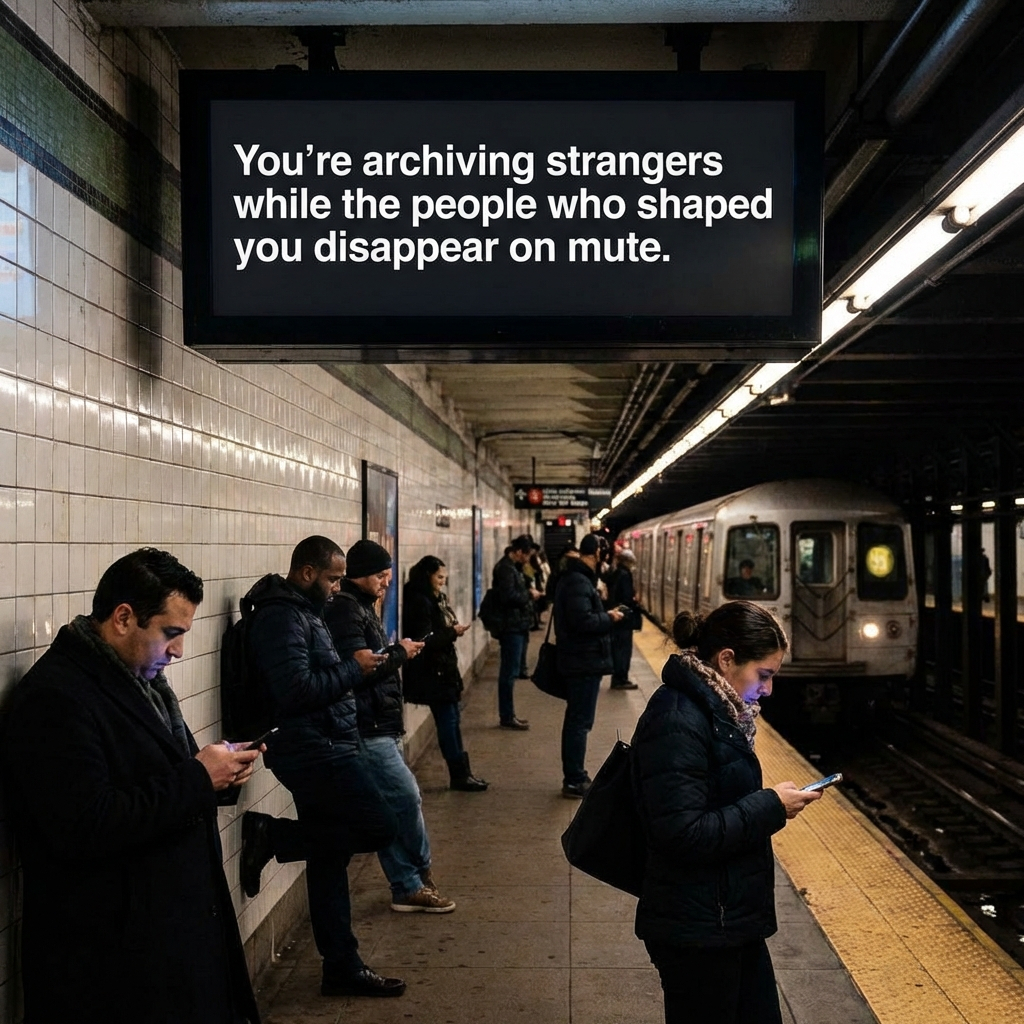
You’re archiving strangers. Influencers. Celebrities. People who will never know your name. Content creators who produce endless streams of material designed to capture your attention for eight seconds before moving to the next thing.
You have hours of that content saved. Carefully organized. Backed up to the cloud. Preserved for future access.
Meanwhile, the people who shaped you? The ones whose voices you’ll desperately want to hear again? You’re trusting your memory to preserve them.
Memory is a terrible archive. It degrades. It distorts. It fills in gaps with approximations that feel real but aren’t accurate.
Five years from now, you won’t remember exactly how your grandmother laughed. You’ll remember that she laughed, but the specific sound will be gone. Replaced by a reconstruction that your brain insists is correct but isn’t.
Ten years from now, you won’t remember the exact way your father said your name. The inflection. The tone. The specific quality of his voice that made it unmistakably him.
You’ll have a general sense of it. An approximation. But the actual recording? That’s gone.
Unless you capture it now. Intentionally. While it still exists.
What Happens Next
You have two options.
You can keep assuming tomorrow is guaranteed. Keep postponing the recordings you know you should make. Keep trusting that there will be time later, when the moment feels right, when you’re less busy, when the timing is better.
Or you can recognize that the asymmetry is absurd. That you’re preserving strangers while neglecting the people who actually matter. That the grief tax is real and expensive and completely avoidable.
The technology exists. The barriers are removed. The only thing standing between you and preserving what matters most is your willingness to confront the fact that time is the only truly non-renewable resource.
So here’s the uncomfortable question you need to answer:
What are you waiting for?
Leave a Reply
You must be logged in to post a comment.